What I shared on The New Data Economy podcast, and why it's the conversation every team should be having with us.
I recently sat down with Kate Parker on The New Data Economy podcast. Somewhere around minute ten, I realized we were connecting every dot I've been writing about this year. Signals. Orchestration. Native apps. Putting fan data to work. So here's the highlight reel. The most important points. If something sparks, watch or listen to the full episode for the deeper dive.
The short version
The last two decades were about collecting fan data. The next one is about using it. And you don't need to rip out your tech stack to get there.
✔️ Stay agile. Keep the vendors that work. Try new ones without a two-year migration. Lean into legacy where it still earns its keep.
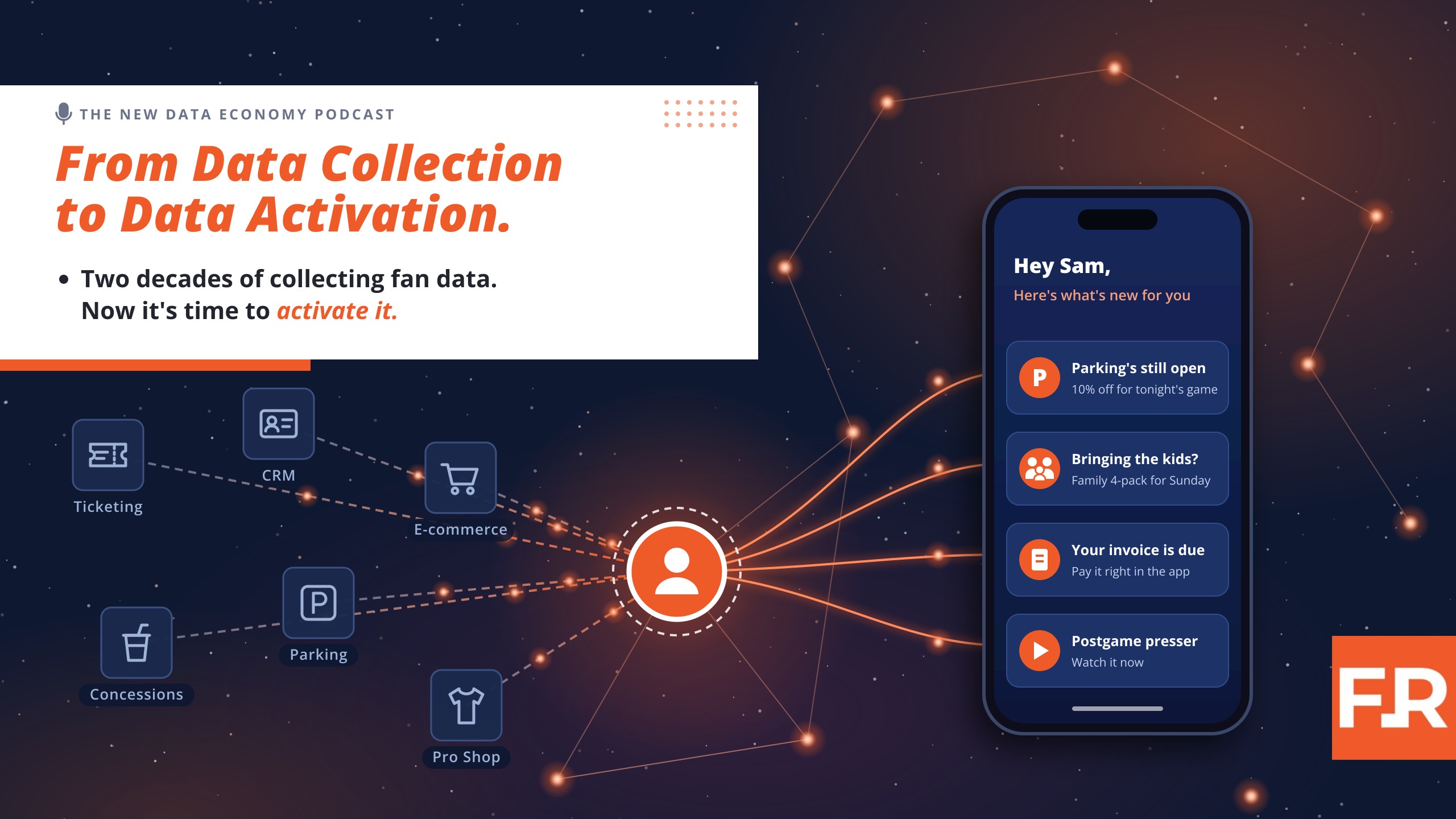
✔️ Aggregate, don't replace. Ticketing, CRM, e-commerce, concessions. Bring it together instead of starting over.
✔️ Activate, don't just collect. Data sitting in a silo isn't an asset. Data that changes a fan's experience is.
✔️ Go one-to-one. The right message to the right fan, in the moment. Personalize.
✔️ Start with value. If it doesn't make the fan's experience better, don't build it.
That's the whole strategy. Here's how it played out in the conversation.
Where is data heading in live sports?
For the last decade or two, the focus was collection. Every vendor, every touchpoint, every system. The result? Data scattered across silos.
The game changer now is simple: we have all this data, so how do we activate it? How do we aggregate it, orchestrate it and actually use it? With AI, the speed of getting that logic to market is about to change everything, especially in marketing. In live sports and entertainment, that means engagement, revenue and sponsorship.
What does the "new data economy" mean?
One word: one-to-one.
A native mobile app ties a person to a device. That lets us build a rich user model around an individual fan, not a segment.
So I know you have tickets to the next game. I know you haven't bought parking. I know you're bringing your kids. When you open the app, I can talk to you. "Hey, you still need parking. Here's 10% off." Maybe a deal on a kid's jersey or a hot dog.
Individual fans are more valuable now. We're done collecting. Now we use it, literally one-to-one.
(More on this in Stop Storing Fan Data, Put It to Work.)
Where does the data get stuck?
Everywhere. Your CRM. Your ticketing provider. Your pro shop. Your e-commerce store. Every one holds a piece of the fan, and historically it took a lot of manual work to extract it, analyze it and decide who to target.
The instinct is to replace systems and consolidate. But that's an infinite cycle. Swap one vendor and you've just created the next silo.
We take a different approach. FanReach aggregates those disparate sources through the mobile app, connects the dots and puts the data into a consistent, actionable format. Add AI that can read across all of it, and now the data drives the fan journey instead of sitting in storage.
You don't have to replace your technology providers. You have to make them work together.
(I wrote about this in Don't Replace. Orchestrate.)
How do you make the case to leadership?
We start with customer journey mapping and goals in three buckets:
✔️ Engagement. Drive visibility and use of a feature or content.
✔️ Utility. Operations spots a bottleneck at a gate? Use the app to reroute fans before they get there.
✔️ Commerce. Once fans are in your world, in person or digital, keep them there and keep them buying.
Pick one or two goals per bucket, then apply proven strategies.
Then we show, not tell. We call them plays, because, well, sports. Small, concrete examples. Your season ticket members are signed into the app to use their tickets. You know they have an invoice due. So when they open the app, remind them to pay it. Simple.
One play becomes three. Three becomes ten. Then the light bulb goes off and it snowballs.
Who owns the fan journey?
This is the problem technology alone doesn't solve. In pro sports, one group sells tickets. Another sells merchandise. Another gets fans through the gates. Another sells them pizza and a beer. Each wants outcomes for its piece of the business, not always for the whole.
But the data crosses lines. A fan who keeps buying kids' jerseys, a baby onesie and extra hot dogs? That's a signal for the ticketing team. This fan probably has a family. Market them a family four-pack.
Part of every play is showing each department why its data matters to the whole.
What's changing at enterprise scale?
Signals. In real time.
Every tap in a branded app is an analytics event. A fan opens a preference center and taps "press conferences." Right then, their content filters to press conferences. They tap a player on the roster screen (I'll use Tom Brady even though he's retired. Old Patriots habits.), and the app instantly surfaces what's relevant to that player.
No waiting on a data team to rebuild a user model. The experience transforms in the moment. Think Netflix recommendations, brought into pro sports.
Geography works the same way. Say you're a Patriots fan living in California. Why push you ticket offers? Instead, show you where to stream the game and what's new in the pro shop.
(The full story is in Signals: Listen to Your Fans & Deliver.)
Isn't an app just an extension of the website?
That's how we treated apps for 15 years. A place to read an article, check a press release, feel some brand affinity. A nice-to-have.
That thinking is outdated. With the data you can tie to a device and the one-to-one messaging it enables, your app may be your number one marketing channel.
And it's not just sports. If you're Volvo, your app already starts my car. But you also know my car. Tell me when my oil change is due. Flag low tire pressure. Offer me a trade-in deal when I open the app. Your website will never know me like that. I have to go to it. The app comes with me.
(See Native Mobile Apps Are More Critical Than Ever and The Future of Brand Communication Is in Your Pocket.)
Where do teams stumble?
Honestly? People, not technology.
Teams need staff who know how to collect data, how to use it, and how to put AI to work on it at scale. AI changes every week. Humans are trying to keep up.
Pro sports adds turnover. Talented young marketers get a season of reps, then get promoted, switch departments or move to another team. Sustaining campaigns over the long haul is hard for every brand.
That's exactly why the plays need to live in the platform, not in one person's head.
Is privacy part of the conversation?
Yes. The leagues have driven data privacy and compliance from the top down, and everyone takes it seriously.
Apps now give fans granular control, much like cookie consent on a website. Allow the ticketing SDK because I need my tickets. Skip the sweepstakes.
I see that as a good thing, not a restriction. The more a fan trusts you, the more they'll share. The more they share, the better you can serve them. And it cuts the noise. Brands blasting everyone with everything get tuned out. Regulation pushes all of us to be more strategic.
Full circle: does it add value?
Back in my Patriots days, every new initiative started with one question: Does this add value for the fan?
If yes, we planned, strategized and workshopped. If no, full stop. We didn't pursue it.
That question still drives everything we build at FanReach. Signals, orchestration, one-to-one messaging. None of it matters unless the fan's experience gets better.
Don't forget: the data is people.
Aggregate what you already have. Stay agile with what comes next. Put your data to work for the fan.
Kate and I also got into my path from a college new media class to two decades of firsts with the Patriots, and what coaching high school soccer has taught me about building teams. Watch or listen to the full episode above.
Ready to stop collecting and start activating? Let's talk.